
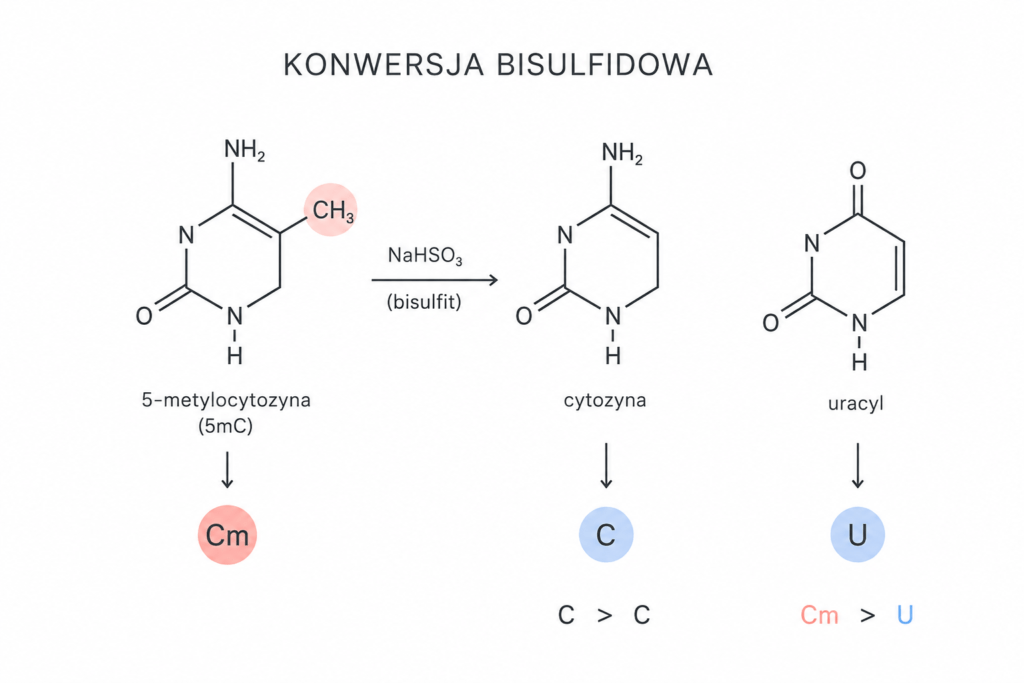
Whole Genome Bisulfite Sequencing is the most comprehensive DNA-methylation analysis method, enabling single-nucleotide-resolution analysis of methylation patterns across the entire genome. It combines chemical bisulfite conversion of DNA with next-generation sequencing, providing the highest resolution for epigenetic studies.
The method identifies methylated cytosines in both genic and intergenic regions, providing a complete view of epigenetic changes in the biological material under study.
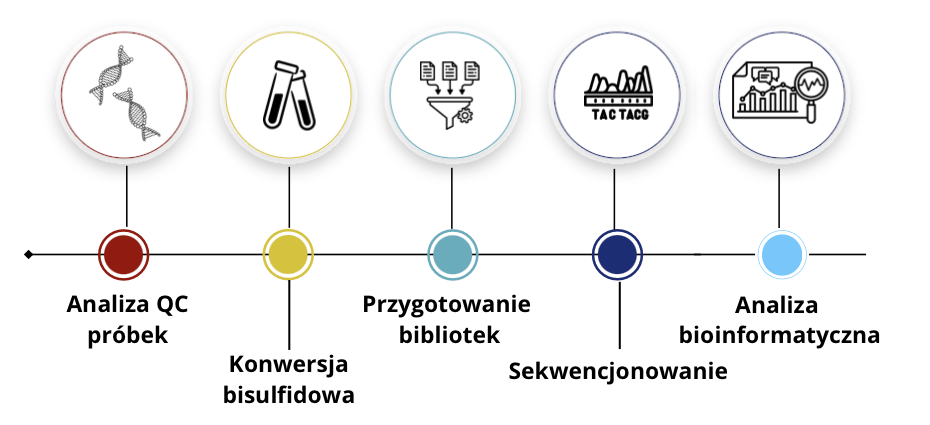
WGBS workflow
- read quality control,
- sequence mapping to the reference genome,
- identification of methylated cytosines,
- determination of methylation levels,
- differential-methylation analysis between samples,
- preparation of reports and result visualisations.
Applications of WGBS
WGBS is used in a broad range of basic and applied epigenetic studies.
Cancer research
- identification of epigenetic biomarkers,
- analysis of cancer-development mechanisms,
- study of tumour heterogeneity,
- monitoring response to therapy.
Translational medicine and diagnostics
- discovery of diagnostic and prognostic markers,
- research on genetic and epigenetic diseases,
- development of personalised medicine.
Developmental studies
- analysis of epigenetic changes during cell differentiation,
- embryogenesis studies,
- assessment of organismal ageing processes.
Plant and animal biology
- analysis of gene expression regulation,
- studies of environmental adaptation,
- breeding projects and functional genomics.
Environmental and toxicological studies
- assessment of environmental-factor effects on the epigenome,
- studies of organismal responses to environmental stress,
- analysis of the effects of chemical exposure.
Technical specifications of WGBS
- Sequencing mode: 2x150 bp
- Sequencers: Illumina platform, NovaSeq 6000 and NovaSeq X sequencers.
- Recommended genome coverage:
- 30x per sample - at least 3 biological replicates and an available high-quality reference genome
- Other configurations are also available depending on the client's needs.
- Recommended Sample Requirements - DNA/RNA:
- Sample type: genomic DNA
- Amount: >100 ng
- Concentration (NanoDrop): >2 ng/μL
- Volume: >20 μL
- No degradation or contamination
- Also available: DNA isolation from submitted samples. Details here.
WGBS bioinformatics analysis
Bioinformatics analysis of WGBS data includes multi-stage processing and interpretation of sequencing results, leading to comprehensive characterisation of the organism's methylome.
- Data quality control:The first stage assesses raw sequencing-data quality. Parameters include read quality, adapter content, duplication level and bisulfite-conversion efficiency. Data are then filtered and cleaned before further analysis.
- Mapping to the reference genome.Filtered reads are mapped to the appropriate reference genome using algorithms designed for bisulfite-converted data. The report includes:
- read-mapping statistics,
- genome-alignment efficiency,
- sequencing depth,
- coverage of analysed cytosine positions,
- assessment of data completeness for individual genomic regions.
- DNA-methylation identification.Mapped reads are used to identify DNA-methylation sites at single-nucleotide resolution. The analysis includes:
- identification of methylated cytosines (mC),
- determination of methylation level at each site,
- characterisation of methylation contexts:
- mCG (CpG),
- mCHG,
- mCHH (where H = A, T or C),
- analysis of methylated-site distribution across the genome,
- identification of sequence motifs associated with methylation.
- Genome-wide methylation profilingThe next stage comprehensively characterises the epigenetic landscape of the genome. The analysis generates:
- genome-wide methylation-density and distribution profiles,
- methylation levels in functional regions (promoters, exons, introns and intergenic regions),
- methylation profiles in gene upstream and downstream regions,
- analysis of CpG-island methylation, CpG shores and adjacent regions,
- annotation of genes associated with observed methylation patterns.
- Inter-group comparison.Comparative projects include differential-methylation analysis between study groups or experimental conditions. This includes:
- identification of differentially methylated regions (DMRs),
- annotation of DMRs relative to genes and regulatory elements,
- identification of genes associated with differential methylation,
- GO (Gene Ontology) functional enrichment analysis,,
- KEGG (Kyoto Encyclopedia of Genes and Genomes) pathway analysis,,
- biological interpretation of epigenetic changes in the context of the process or phenotype studied.
The final output is a detailed report containing methylation profiles, statistical-analysis results, identification of differentially methylated regions and functional interpretation of the results.
Selected projects and client publications
See which institutions we perform next-generation sequencing (NGS) for and explore scientific publications that draw on the data we have supplied.